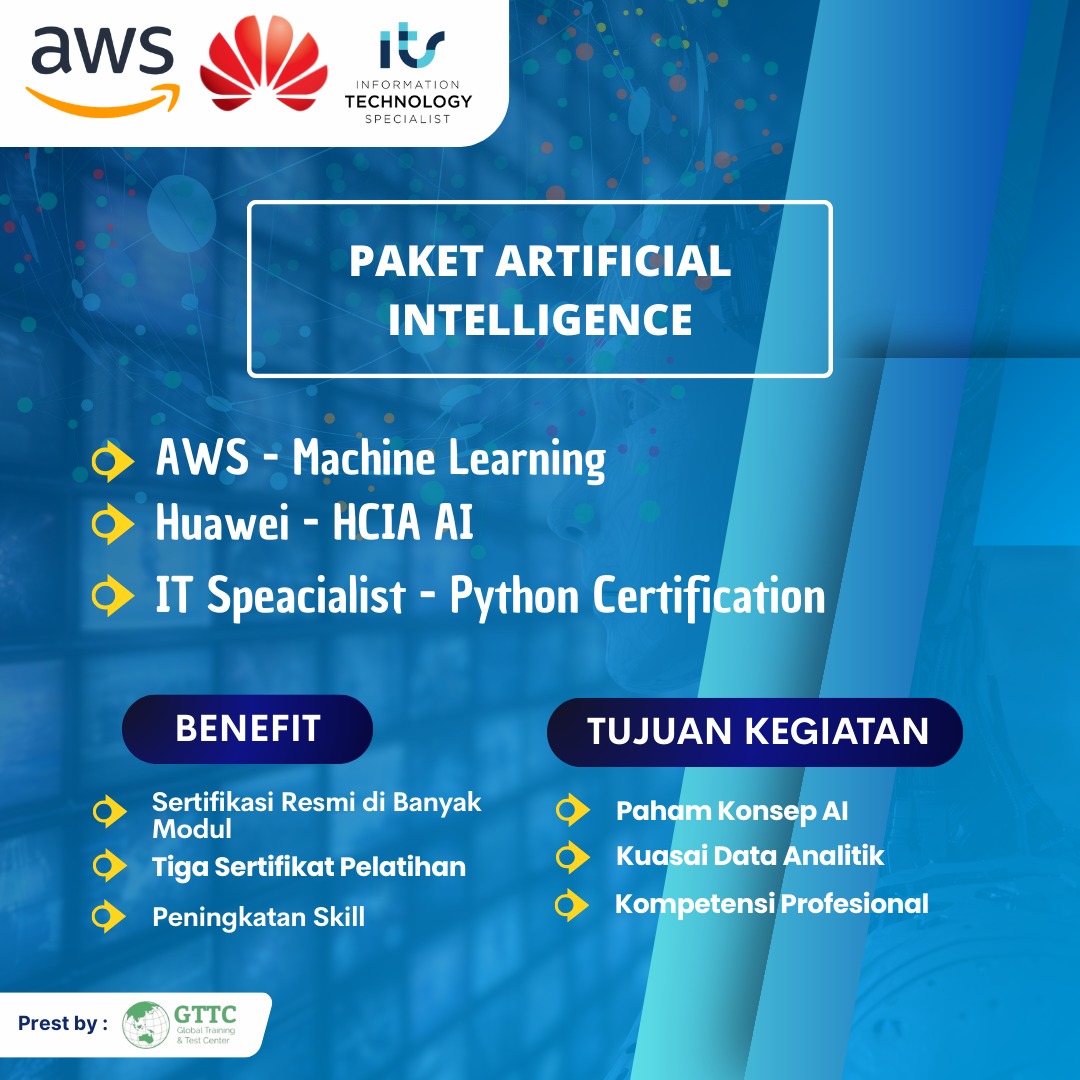
Program Combo Februari (Paket Artificial Intelligence)
Description
1. AWS Machine Learning
AWS Academy Machine Learning Foundations introduces participants to artificial intelligence and machine learning concepts and terminology. After attending this course, participants will be able to select and apply machine learning services to solve business problems. Participants will also be able to label, build, train, and deploy custom machine learning models through a guided practical approach.
In this course, participants will learn:
- Welcome to AWS Academy Machine Learning Foundation
- Introducing Machine Learning
- Implementing Machine Learning pipelines with Amazon SageMaker
- Introducing Forecasting
- Introducing Computer Vision
- Introducing Natural Language Processing
2. Huawei - HCIA AI
The HCIA–AI (Huawei Certified ICT Associate – Artificial Intelligence) program is an entry-level training designed to provide participants with a solid foundation in Artificial Intelligence (AI) concepts, technologies, and real-world applications. This program is part of Huawei’s official certification pathway, which is globally recognized and widely adopted by universities, ICT academies, and professional training centers worldwide. The training introduces core AI domains such as machine learning, deep learning, computer vision, and natural language processing (NLP), along with an overview of the Huawei AI ecosystem. Participants will gain insight into how AI technologies are applied across industries, including smart cities, healthcare, finance, manufacturing, and digital services. The HCIA–AI program is suitable for students, entry-level IT professionals, and individuals who want to start or strengthen their career in Artificial Intelligence, Data Technology, and ICT innovation.
The curriculum follows the official Huawei HCIA–AI syllabus, covering the following topics:
-
Introduction to Artificial Intelligence
- Fundamentals and evolution of Artificial Intelligence
- The role of AI in digital transformation
- AI applications across various industries
-
Machine Learning Fundamentals
- Supervised, unsupervised, and reinforcement learning
- Datasets, feature engineering, and model training
-
Basic machine learning algorithms and model evaluation
-
Deep Learning Concepts
- Neural networks and deep neural networks
- Convolutional Neural Networks (CNN)
- Recurrent Neural Networks (RNN)
-
Overview of deep learning frameworks
-
Computer Vision
- Fundamentals of digital image processing
- Image classification and object detection
-
Industrial applications of computer vision
-
Natural Language Processing (NLP)
- Basic concepts of natural language processing
- Text classification and sentiment analysis
-
NLP applications such as chatbots and intelligent services
-
Huawei AI Ecosystem & Platforms
- Overview of Huawei AI solutions and ecosystem
- AI application scenarios and industry use cases
-
Introduction to Huawei AI development tools.
3. IT Speacialist - Python Certification
Candidates for this exam will demonstrate that they can recognize, write, and debug Python code that will logically solve a problem.
Curriculum Highlights
1.Operations using Data Types and Operators
· Evaluate expressions to identify the data types Python assigns to variables
· Perform data and data type operations
· Determine the sequence of execution based on operator precedence
· Select operators to achieve the intended results
2.Flow Control with Decisions and Loops
· Construct and analyze code segments that use branching statements
· Construct and analyze code segments that perform iteration
3.Input and Output Operations
· Construct and analyze code segments that perform file input and output operations
· Construct and analyze code segments that perform console input and output operations
4.Code Documentation and Structure
· Document code segments
· Construct and analyze code segments that include function definitions
5.Troubleshooting and Error Handling
· Analyze, detect, and fix code segments that have errors
· Analyze and construct code segments that handle exceptions
· Perform unit testing
6.Operations using Modules and Tools
· Perform basic operations by using built-in modules
· Solve complex computing problems by using built-in modules

Offered by Amazon Web Services (AWS)
Authorized Partner
- Due: 31 Dec 2026
- Type: Training & Test
- Category: Special Price