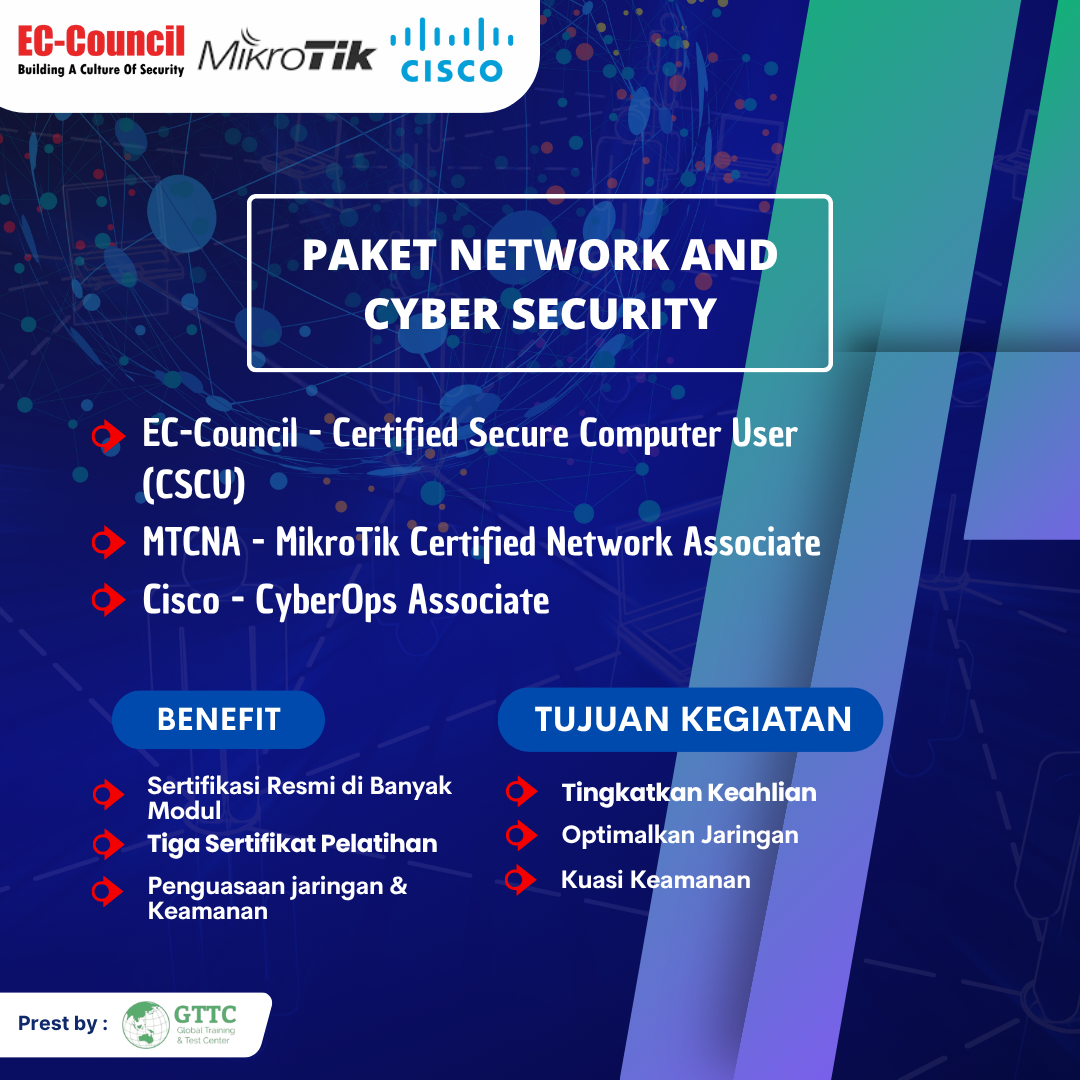
1. EC-Council - Certified Secure Computer User (CSCU)
Certification: Certified Secure Computer User (CSCU) program is designed to equip individuals with essential knowledge and skills to protect their information assets. Through an interactive learning environment, participants will gain a solid understanding of various computer and network security threats, including identity theft, credit card fraud, phishing attacks, viruses, hacking, and social engineering.
Curriculum Highlight :
Data Backup & Protection
-
Social Network Security
-
Antivirus Protection
-
Disaster Recovery
-
Internet & Email Security
-
Credit Card & Online Transaction Security
-
Monitoring Kids Online
-
Wireless & Home Network Security
-
Operating System (OS) Security
-
Cloud Security
-
Password Security
-
Social Engineering Countermeasures
-
Identity Theft Prevention
-
Mobile Device & IoT Security
-
Gaming Console Security
-
Securing Remote Work
-
Physical Security
2. MicroTik - MTCNA
The MikroTik Certified Network Associate (MTCNA) certification is designed for individuals who want to demonstrate proficiency in configuring, managing, and troubleshooting networks using MikroTik RouterOS software and RouterBOARD hardware. Here's an overview of what the MTCNA certification entails:
- Basic Networking Concepts: Understanding fundamental networking concepts such as IP addressing, subnetting, routing, switching, VLANs, and OSI model.
- MikroTik RouterOS Introduction: Familiarizing with the features and capabilities of MikroTik RouterOS, including its interface, command-line interface (CLI), and graphical user interface (WinBox).
- Router Configuration: Configuring MikroTik routers for basic connectivity, including setting IP addresses, configuring interfaces, and establishing simple routing.
- Wireless Networking: Configuring wireless interfaces, setting up wireless security (WPA/WPA2, encryption), managing wireless clients, and optimizing wireless performance.
- Firewall Configuration: Implementing firewall rules to control traffic flow, filter packets, and secure the network against unauthorized access and attacks.
- Network Address Translation (NAT): Configuring NAT to enable communication between private and public IP networks, including source NAT (SNAT) and destination NAT (DNAT).
- Quality of Service (QoS): Implementing QoS policies to prioritize traffic and ensure optimal performance for critical applications, such as VoIP or video streaming.
- IP Services Configuration: Configuring various IP services such as DHCP server, DNS server, VPN (Virtual Private Network), and PPPoE (Point-to-Point Protocol over Ethernet).
- Network Monitoring and Management: Using tools and features for monitoring network traffic, bandwidth usage, and device health, as well as managing network resources and configurations.
3. Cisco - CyberOps Associate
Troubleshooting: Identifying and resolving common network issues using troubleshooting techniques, diagnostic tools, and logs provided by MikroTik RouterOS.
Curriculum Highlight :
- Threat Analysis: Identification of malware, DDoS attacks, and exploits.
- Security Monitoring: Use of SIEM (Security Information and Event Management) tools.
- Incident Response: Procedures for handling security incidents.
- Network Security: Implementation of firewalls, IDS/IPS, and data encryption.
- Translated with www.DeepL.com/Translator (free version)